Friday, 10 April 2020

Covid-19: How long does the coronavirus last on surfaces?


We can pick up the Covid-19 by touching surfaces contaminated with the new coronavirus, but it is only just becoming clear how long the virus can survive outside the human body.


As Covid-19 has spread, so has our fear of surfaces. There are now some familiar scenes in public places around the world – people trying to open doors with their elbows, commuters studiously surfing their way through train journeys to avoid grabbing a handle, office workers rubbing down their desks each morning.

In the areas worst hit by the new coronavirus, teams of workers in protective clothing have been dispatched to spray a fog of disinfectant in plazas, parks and public streets. Cleaning regimes in offices, hospitals, shops and restaurants have been increased. In some cities, well-meaning volunteers even venture out at night to scrub the keypads of cash machines.

Like many respiratory viruses, including flu, Covid-19 can be spread in tiny droplets released from the nose and mouth of an infected person as they cough. A single cough can produce up to 3,000 droplets. These particles can land on other people, clothing and surfaces around them, but some of the smaller particles can remain in the air. There is also some evidence that the virus is also shed for longer in faecal matter, so anyone not washing their hands thoroughly after visiting the toilet could contaminate anything they touch.

It is worth noting that, according to the Centers for Disease Control and Prevention, touching a surface or object with the virus and then touching one's own face "is not thought to be the main way the virus spreads". Even so, the CDC, the World Health Organization and others health authorities, have emphasised that both washing one's hands and cleaning and disinfecting frequently touched surfaces daily are key in preventing Covid-19's spread. So although we still don't know exactly how many cases are being caused directly by contaminated surfaces, experts advise exercising caution.


One aspect that has been unclear is exactly how long Sars-CoV-2, the name of the virus that causes the disease Covid-19, can survive outside the human body. Some studies on other coronaviruses, including Sars and Mers, found they can survive on metal, glass and plastic for as long as nine days, unless they are properly disinfected. Some can even hang around for up to 28 days in low temperatures.

Coronaviruses are well known to be particularly resilient in terms of where they can survive. And researchers are now beginning to understand more about how this affects the spread of the new coronavirus. (Read more about the global fight against Covid-19.)

The virus that causes Covid-19 is thought to survive for longer on hard surfaces than on materials such as cardboard 


Neeltje van Doremalen, a virologist at the US National Institutes of Health (NIH), and her colleagues at the Rocky Mountain Laboratories in Hamilton, Montana, have done some of the first tests of how long Sars-CoV-2 can last for on different surfaces. Their study, which has been published in the New England Journal of Medicine, shows that the virus could survive in droplets for up to three hours after being coughed out into the air. Fine droplets between 1-5 micrometres in size – about 30 times smaller than the width of a human hair – can remain airborne for several hours in still air.

It means that the virus circulating in unfiltered air conditioning systems will only persist for a couple of hours at the most, especially as aerosol droplets tend to settle on surfaces faster in disturbed air.

But the NIH study found that the Sars-CoV-2 virus survives for longer on cardboard – up to 24 hours – and up to 2-3 days on plastic and stainless-steel surfaces. (Learn how to clean your mobile phone properly.)

The findings suggest the virus might last this long on door handles, plastic-coated or laminated worktops and other hard surfaces. The researchers did find, however, that copper surfaces tended to kill the virus in about four hours.

But there is a speedier option: research has shown that coronaviruses can be inactivated within a minute by disinfecting surfaces with 62-71% alcohol, or 0.5% hydrogen peroxide bleach or household bleach containing 0.1% sodium hypochlorite. Higher temperatures and humidity also tend to result in other coronaviruses dying quicker, although research has shown that a related coronavirus that causes Sars could be killed by temperatures above 56°C or 132°F (hotter than even a bath scalding enough to cause injury) at a rate of about 10,000 viral particles every 15 minutes.

By Richard Gray.


Wednesday, 15 August 2018

22 Children Feared Dead

At least 22 children have drowned in Sudan when their boat sank in the Nile while they were on their way to school, according to official media.

 A woman also died when the vessel went down around 750km north of the capital, Khartoum, with more than 40 children on board, the SUNA news agency reported on Wednesday.The accident occurred when the boat's engine broke down as result of heavy rains and winds in Beheir district in the Nile River state.

Civil defense forces were still searching the Nile river for the bodies of the victims.Villagers in the region rely on wooden boats to cross the Nile.

A witness told AFP news agency by telephone that the boat had been crossing the river against the current."All the families [in the area] are in mourning," added the witness, who did not want to be named.

Early on Wednesday, Sudanese authorities ordered the closure of schools across Khartoum amid heavy torrential rains and winds that have destroyed hundreds of homes in some provinces, including North Darfur and North Kordofan.Nearly 40 people have been killed due to heavy rains since last week, including 10 in Khartoum, according to local media. Sources : News agencies.

Thursday, 3 May 2018

Police are responding to reports of a shooting at the Opry Mills Mall in Nashville, Tennessee.


Police are responding to reports of a shooting at the Opry Mills Mall in Nashville, Tennessee

1:05 pm - 3 May 2018

Sunday, 29 April 2018

Eugene Cole killed

Fugitive suspect in killing of deputy captured.
Associated Press•April 29, 2018
NORRIDGEWOCK, Maine (AP) — A man accused of killing a sheriff's deputy was arrested Saturday outside a remote cabin, ending an intense manhunt in its fourth day in the woods of central Maine.
A law enforcement team used the slain deputy's handcuffs to arrest 29-year-old John Williams in a symbolic gesture, Sheriff Dale Lancaster said.


"We can now focus on the important task of respectfully laying our fallen brother to rest. Tonight, the citizens of Somerset County can sleep well and knowing that a dangerous man has been taken off the streets," the sheriff said.
Williams was wanted in the fatal shooting of Cpl. Eugene Cole early Wednesday after the two had an encounter on a darkened road in Norridgewock.
Cole, 62, had been involved in the arrest of Williams' girlfriend several days earlier, and Williams was worried about being arrested himself for failing to appear in court in Massachusetts on firearm charges the day of the shooting.
Williams was angry about his girlfriend's arrest and had told a friend that "as of tomorrow, I'll be a fugitive." The friend said Williams was acting paranoid and noticed he had body armor in one of his bags.
Shirtless and shoeless when captured, Williams appeared to be exhausted when he was led out of the woods Saturday. Officers put him into the back seat of an unmarked state police vehicle, and detectives whisked him away.
"I'm just glad it ended peacefully, and no one else got hurt," said Tasha Raymond, whose kids have been forced to play indoors for the past four days.
The arrest brought some closure to the deputy's family and relief to residents who've been "on edge," said Larry Tilton, a friend of Cole's.
ads: Colourful female wrist watch!!
The community of 3,500 had been nervous since scores of police officers poured into the region during the manhunt. Helicopters, cruisers and tactical vehicles prowled the region.
On Saturday, about 150 officers were searching in a wooded area where police believe Williams was cornered when a team including FBI, game wardens and local police located him outside the cabin.
He offered "limited resistance" when being arrested and taken to the Waterville Police Department for questioning, police said. He's expected to make his initial court appearance in the next few days.
It was unclear if Williams has an attorney to speak on his behalf.
Before the arrest, the wife of the slain deputy had implored his killer Saturday to turn himself in, or at least reach out to police.
Sheryl Cole promised to Williams that he'd be treated the way her late husband would've treated him: "with dignity and respect."
Cole became the first law enforcement officer in Maine to be killed in the line of duty in nearly 30 years.
He was a 13-year veteran of the department who was known for being respectful and patient in his dealing with people. Lancaster described him an "outstanding employee, one of the finest deputies."
A funeral for the popular deputy is scheduled for May 7, at a civic center in Bangor.
___
David Sharp contributed to this report from Portland.

Tuesday, 18 July 2017

Swiss glacier reveals couple lost in 1942


The spot where the two bodies were found in glacierImage copyright Télévision Suisse Romande Image caption Bernhard Tschannen shows where the bodies were found in the ice
A shrinking glacier in Switzerland has revealed two frozen bodies believed to be of a couple who went missing 75 years ago, Swiss media report.

Marcelin and Francine Dumoulin disappeared after going to tend to their cows in the Alps in 1942.

The couple had seven children.

Their youngest daughter, 79, said the news brought her a "deep sense of calm" and she wanted to give them the funeral they deserved.

"We spent our whole lives looking for them," Marceline Udry-Dumoulin told Lausanne daily Le Matin.

 Local police said the bodies were discovered last week on Tsanfleuron glacier, above the Les Diablerets resort, by a worker from ski-lift company, Glacier 3000.

Director Bernhard Tschannen said his employee found some backpacks, tin bowls and a glass bottle, as well as male and female shoes, and part of a body under the ice.

He said that it was likely the couple had fallen into a crevice and the way they were dressed implied that they could have been there for 70 or 80 years.

"The bodies were lying near each other. It was a man and a woman wearing clothing dating from the period of World War Two," he told Le Matin.

Ms Udry-Dumoulin said her mother, a teacher, never usually went on such walks with her husband, a shoemaker, because she spent much of her adult life pregnant and it was difficult terrain.

She said her and her siblings were placed with different families, and lost contact over the years.

She told Le Matin that she wanted to hold a long-awaited funeral, but would not wear black.

"I think that white would be more appropriate. It represents hope, which I never lost," she said.

Sunday, 28 May 2017

Climate change: Trump keeps world waiting on Paris deal


Donald Trump has said he will decide whether to pull out of a key climate change deal in the next week, having apparently shrugged off pressure from US allies in recent days.
The US president tweeted he would make his "final decision" on the Paris accord after his return to Washington.
Mr Trump left the G7 summit in Sicily on Saturday without reaffirming his commitment to the accord, unlike the other six world leaders in attendance.
He previously threatened to pull out.
Mr Trump, who has called climate change "a hoax" on occasion, has reportedly indicated this is still his position to key members of his inner circle.
The uncertainty over his position on the Paris agreement puts him at odds with other members of the G7.

What is the Paris accord?

The Paris deal is the world's first comprehensive climate agreement, set out in 2015, with the aim of keeping the global average rise in temperatures below 2C.
In order to do that, countries pledged to reduce their carbon emissions.

U.S. President Barack Obama shakes hands with Chinese President Xi Jinping during their meeting at the start of the climate summit in Paris November 30, 2015.Image copyrightREUTERS
Image captionBarack Obama, pictured with Chinese President Xi Jinping during the Paris summit, signed the agreement in 2016

But it came into force only after being ratified by 55 countries, which between them produce 55% of global carbon emissions.
Barack Obama signed the US up in September 2016, and members of the G7 are keen for the US to continue to back it, not least because the country is the second largest emitter of greenhouse gasses after China.

Why doesn't Donald Trump like the agreement?

Mr Trump told voters on the campaign trail he wanted to scrap agreements "contrary to the national interest", while repeatedly promising to strengthen the coal industry.
Coal power is a major contributor to carbon emissions. However, Mr Trump wants to boost coal production to create more jobs.
He has also expressed doubt about the causes of climate change, saying it is a "hoax" made up by China.

Will the US withdraw?

The Axios news site suggests Mr Trump is leaning that way currently, citing three sources who say his mind is made up, and that the wheels are quietly being put in motion behind the scenes.
This is despite US defence secretary James Mattis saying in an interview to air on Sunday that the president is now "wide open" on the issue.
Withdrawal would risk making Mr Trump unpopular not only with his allies abroad, but also with activists at home.

U.S. President Donald Trump talks to German Chancellor Angela Merkel and Tunisia's President Beji Caid EssebsiImage copyrightAFP
Image captionMr Trump's attitude to climate change made discussions at the G7 "very difficult"

It was noted his attitude to climate change was one of the major hurdles during the summit in Sicily - the first time he has met his fellow G7 leaders as a group.
His stance left him isolated, with Mr Trump's reluctance to reaffirm his commitment clearly annoying German chancellor Angela Merkel, who told reporters: "The entire discussion about climate was very difficult, if not to say very dissatisfying."

What would be the effect?

There are fears the US pulling out may lead to other, smaller countries following suit.
Even if they do not, as the US has such a large carbon footprint, it will mean the impact of the agreement will likely be lessened significantly.
Whatever the US chooses, the EU, India and China say they will stick to their pledges made in Paris.
And what's more, some of Mr Trump's own country is likely to ignore his scepticism.
New York and California have already pledged to combat climate change without the Trump administration's support.

Saturday, 27 May 2017

Beyonce holds big baby bash


It was probably exactly like the baby shower you and your partner held, except ever so slightly more decadent.
The singer celebrated her pregnancy with friends and family with an African-themed shindig on Saturday
E News reports that Beyoncé celebrated with her star friends in a Beverly Hills house once owned by Madonna.
The new mum-to-be had her bulging baby(ies) bump adorned with a big henna tattoo (above) and guests enjoyed a soul-food buffet and a boogie to some traditional music and stomping Afrobeat.
Ex-Destiny's Child bandmates Michelle Williams and Kelly Rowland were in attendance at 'The Carter Push Party', as well as tennis star Serena Williams and plenty of other US socialites.

The countries that cane their convicts

A woman on her knees is flogged in Aceh state by a hooded manImage copyrightGETTY IMAGES
Image captionFlogging is a common punishment in Aceh state, where authorities have adopted Sharia law
Two men are due to be caned in public after they were caught in bed together in Aceh, Indonesia.
The men will each receive 85 lashes in public, as punishment under the strict Islamic laws used in Aceh.
It is the only Indonesian province where Sharia is in force. According to human rights campaign group Amnesty International, 108 people were punished for various offences in 2015.
Their offences ranged from gambling to alcohol, adultery and public displays of intimacy outside of marriage.
Pictures of these public punishments - designed to humiliate as much as to injure - show people being led onto a raised platform, and made to kneel or stand as a hooded man beats them with a long, thin cane while a large crowd watches.
Caning is considered so barbaric that Amnesty says it could be considered akin to torture.
But flogging as a punishment for transgressions in countries where Islamic laws are followed is relatively common.
In Sudan, women can be flogged for dressing "indecently". In Saudi Arabia, a woman driving a car can be enough to warrant the sentence. In Iran, attending a party with both men and women can end with being whipped.
Protesters simulate a flogging in front of the Saudi embassy in Washington,DC on January 15, 2015 during a demonstration against the 10-year prison sentence and 1,000 lashes of Saudi activist Raef Badawi for 'insulting Islam' in a blogpostImage copyrightAFP
Image captionRaif Badawi was sentenced to 1,000 lashes in Saudi Arabia, prompting protests around the world
One woman flogged for doing just that described on the Iranian Facebook page My Stealthy Freedoms how she was led into a room in shackles and beaten by a woman.
"With the impact of the first lash, I jumped out of my [seat] uncontrollably," the woman wrote. "I was so shocked that even my tears would not drop. I wanted to scream, but I could not even control my voice."
But probably the most famous case in recent years is that of Raif Badawi, a Saudi blogger sentenced to 1,000 lashes and 10 years in prison for "insulting Islam" online.
So far, authorities have only carried out the first 50 lashes. The public outcry appears to have had some success in halting the sentence, but it still hangs over him.
In the Maldives, where Sharia law is mixed with English common law, flogging is also legal punishment, most commonly used on those convicted of having extramarital sex. The majority of cases are women.
Caning is also used as a punishment in Malaysia, Singapore and Brunei, a legacy of British colonial rule in the 19th Century.
Unlike the public floggings in Aceh, however, these punishments take place behind closed doors, with the accused tied to specially constructed frames and carried out with a doctor in attendance.
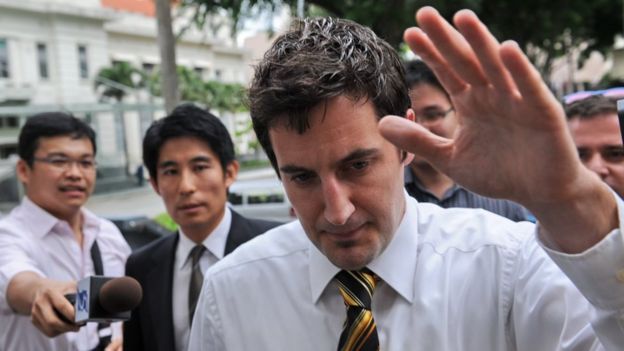
Swiss software consultant Oliver Fricker tries to avoid the media as he walks to the Subordinate court in Singapore on June 24, 2010.Image copyrightAFP
Image captionSwiss software consultant Oliver Fricker (pictured) was caned for spray painting graffiti in Singapore
Its use is relatively widespread: in Singapore 2,203 people were caned in 2012, including 1,070 foreigners, the US State Department said.
Since 2010, at least three Europeans have been sentenced to be caned for vandalism, including Swiss software consultant Oliver Fricker, who spray-painted graffiti on a train.
But the numbers pale in comparison to Malaysia.
In 2010, Amnesty International released a report saying some 10,000 prisoners and 6,000 refugees were being caned each year, punishment for more than 60 crimes - including drug-related and sexual offences, as well as migration violations.

When mum or dad is an alcoholic

One in five children in the UK are said to be negatively affected by their parents' drinking, and the effects can last well into adulthood. Four women - Karen, Liz, Hilary and Lynne - spoke to Jo Morris about growing up with a parent dependent on alcohol.
"Some people talk about what books they've read, or films they've been to see, but instead we talk about how drunk our parents were," says Karen.
Karen and her friend Liz met at work in their late 20s and quickly bonded when they realised they had a shared history.
"It's not the same talking to somebody who doesn't know what it's like," says Liz.
Gallows humour helps to deal with the horrible memories. Like the time Liz's mum sold her toys to get money for alcohol. Or the time Karen's alcoholic dad went to the pub instead of collecting her from after-school club.
"It's a bit like Top Trumps - alcoholic-parent Top Trumps," Karen laughs.
They both remember dreading the walk home from school.
"It's so disheartening," says Karen. "You think: 'OK, I've had a nice break at school, but here we go again. I'm going to be really polite and be really nice, make sure that I don't say anything out of turn or give you any reason to have a go at me.'"
It was only when Liz was eight or nine that she noticed her friends did not have any such concerns and lived very different lives.
"I thought: 'Oh, you have your dinner cooked for you? I don't even have dinner.'
"That's when you realise it's horrendous and you feel very alone going through it."
Once, her mum spent all her benefit money on alcohol, and all she could afford was a sack of potatoes.
"Potato weekend!" Liz laughs. "We literally had potatoes to live on for the weekend. So we had mashed potato, potato cakes, chips wrapped up in newspaper - she was very resourceful."
Image caption"Potato weekend" - when Liz' mum spent all the money on drink
Food - or the lack of it - is a common theme.
Hilary, 55, grew up in an upper-middle class family in Sunderland, with a respected surgeon as a father. The family kept up appearances - but her mother drank.
"I can remember being at school, and a girl in my form opening up her lunch and saying: 'Oh my sandwiches haven't been buttered to the edge.' It was like Planet Zorg compared to my life," she remembers.
No-one was making sandwiches for Hilary. In fact it was left to her to look after her younger brother - putting him to bed, getting him ready for school, making sure he was fed.
Her mum's drinking started out with a glass of wine "while cooking" but soon escalated to a bottle of vodka a day.
"She was hiding bottles, they were all over the place - in her shoeboxes, you'd find glasses of neat vodka behind curtains and if you put the oven on you checked there wasn't a bottle hidden in there.
Watching her elegant and educated mother fade away was very painful.
"You couldn't hold a conversation with her because she was drunk," Hilary says. "It was like she wasn't there really - she went from being very present to becoming a ghost."
Liz's mother had been a model, but after she began to drink she never quite knew where to put on her make-up. "She looked like Aunt Sally from Worzel Gummidge," she says.
Liz's own life began to spin out of control, as a result of neglect. By the age of 15, Liz had become involved in an abusive relationship, and was put into foster care. It was thanks to her friends that she survived, she says.
"I've been good at choosing good friends who helped me through it, friends who weren't into drugs and drinking."
Then, when she saw her friends go to university she decided she would, too - the only child in Surrey social services at the time who did. "I definitely deserve a prize for that," she says.